
Mobility
"Transportation" has become an exclusive word. It's been captured by leadership and used as ammo to keep you out of the conversation. But the truth is, you don't need to be a transportation planner, engineer, or professional to know what is and isn't working in your community.
We are here with a friendly reminder that your streets should work for you. For your kids, your elderly parent, your disabled neighbor. For all of us, whether or not we drive.
On this page, we'll break down our streets in a way that's so easy, so accessible, and so obvious, that you'll never look at them the same again. We want you to know what is and isn’t working, without being clouded by common misconceptions.
Long Story Pretty Short
Somewhere along the line, our streets were taken from people and given to cars. The Big Car industry became so strong, so powerful, and so rich that it effectively dictated the shape of our cities and communities. With a catchy marketing scheme, Big Car promised customers high status and freedom. They sold cars as the ultimate symbol of luxury. Everybody needed one.
Or so they thought. The thing is, it was recognized very early on that cars were not compatible with people. From the beginning, communities began to fight back as the streets where they once gathered, played, and socialized became very dangerous places. But, with powerful lobbying tactics and thick pocketbooks, Big Car persisted. As the popularity of the personal vehicle increased, it was obvious that society needed to be reshaped to accommodate this product. Because until it was, people wouldn't have enough incentive to purchase one. They wouldn't have the need. So Big Car sat back and thought, "How can we create a world in which every person needs a car?"
Well first, it must be so that no other mode of transportation would be more convenient than the car. The most convenient ways to get around cities set up for people, as cities historically were, are by foot, bike, or public transportation, such as a street car, bus, or train. "We must set cities up for cars," thought Big Car. So homes were cleared and families were displaced to make room for highspeed thoroughfares. Buildings were razed, parking lots were paved. Neighborhoods were dismantled and cities were destroyed.
"But we need more," thought Big Car. So they dictated the public narrative, and we saw firsthand how language shapes society and the public perception. When drivers would kill people with their cars, it was deemed an "accident". "It must never be the car's fault," thought Big Car. So when pushback increased, so too did victim-blaming. Eventually – and it didn't take long – society began to assign more value to cars than it did to people. Streets became "no place to [play, talk, walk, bike, you name it].” Big Car customers who purchased their vehicles for the promise of convenience became enraged at these reckless pedestrians (the term people would no longer suit the narrative), and their behavior towards them made the street an extremely hostile place. Our streets became so uncomfortable for people that only the bravest few with no other option would dare travel outside of a car. (Later, these people are considered underserved.)
And when more and more people came to own a private car, which was deemed the safest and most convenient way to get around a city made for cars (imagine that), the space between buildings became greater and greater to make room for parking those cars. And when Big Car took all the space for cars, eradicating humans from our streets, our leaders made the case that we no longer needed infrastructure to support the humans, because they were so very few. Thus, they disinvested in sidewalks and public transportation, claiming "nobody uses it".
Eventually, Big Car won. It successfully created a society in which every person needs a car to get from point A to point B conveniently, and as they say, "safely" (I urge you to remember all things are relative). Eventually, it was no longer an option to walk, and it was no longer an option to take public transportation – a situation in which one must first walk to their bus stop or transit station. For those who could not afford a car, a trip to the grocery became a day trip, and employment was out of reach. But it's important to remember, they still exist (they are considered marginalized), and our cities do not work for them.
So now that you got the skinny, you can understand how "safety" and "convenience" are buzzwords used by leadership to commission projects that continue to degrade our communities, disproportionately affecting underserved and marginalized populations. You might be one of them. Common Duty will help you transition your mindset from Car Brain to a people-centered approach, simply, quickly, and effectively, reminding you that your public representatives, dollars, and projects should work for you. Not against you.
How does transportation directly affect you?
-
Access to Employment
Safe and reliable transportation to and from work is key to maintaining secure employment and advancing economically.
-
Access to Amenities
Equitable access to grocery stores, healthcare, childcare, and pharmacies means that your needs can be met conveniently.
-
Autonomy & Independence
The ability to travel safely and independently creates more enjoyable childhoods, senior years, and everything in between.
-
Costs & Affordability
Owning a car is expensive. Beyond a car payment, drivers spend thousands of dollars a year on insurance, gas, fees, maintenance, and more.
-
Heath & Wellbeing
Active forms of transportation integrate exercise into our daily lives and mitigate the effects of a sedentary lifestyle.
-
Safety & Convenience
Your local transportation network determines whether or not you can get where you’re going on time and in one piece.
Let’s get street smart.
Buzzwords & Misconceptions
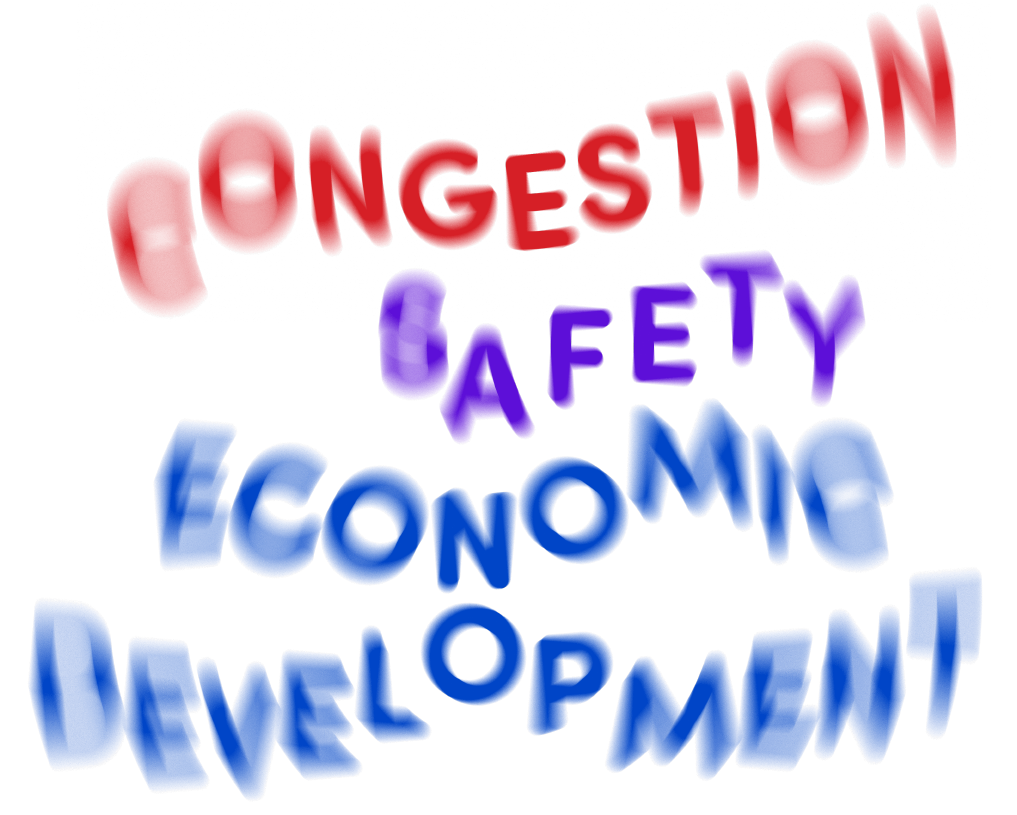
Many transportation projects get the green light for the same inaccurate claims made by engineers and officials. And they sound great in the media, so nobody challenges them. Until now, my friends. Discover the power of recognizing these buzzwords:
-
Nobody can question the need for safety. The problem is, many of the projects commissioned to “increase safety” actually jeopardize it.
Here is one thing to remember: Anything that makes a car go faster does not increase safety—point blank.
Faster cars jeopardize the safety of all road users – including the ones driving the cars.
Check out the next section to learn more about what makes cars go faster.
-
We all want to get where we’re going as quickly and conveniently as possible. I hate sitting in traffic just as much as the next guy. (You know. The next guy. The one who’s making all the traffic.) So when a project is proposed with the promise that it will reduce congestion, everybody’s for it.
However, it’s time you hear the truth. There is only one way to reduce congestion, and that is by getting people out of their cars and into different modalities.
So why don’t these “congestion reducing” projects work? Anything that makes driving easier and more convenient will only lead more people to drive, exacerbating traffic congestion. You may experience a temporary reduction in congestion, but it will usually return, and much worse.
This is called “induced demand”. Watch a 6-minute clip about it here (Vox).
-
You've probably heard that wide roads and vast parking lots are good for the economy. And you've probably heard it so many times that it has to be true, right? So, I want you to ask yourself this question:
"In what contexts have I discovered new local places to shop, eat, and play?"
Maybe you recall coming upon a speciality coffee shop, a candy store, or a boot maker. Maybe it was an art gallery, a fitness facility, or a fresh food store you'd never heard of.
Whatever the case, consider these questions:
Were you walking, biking, or driving?
How fast were you traveling?
The point is, local economies thrive on discovery mode and we don't enter discovery mode when we are traveling by car. Have you ever noticed the quick turnover of local businesses on major arteries? That's because local businesses can't compete with the multi-million dollar marketing budgets of giant corporations like Wal-Mart, Lowe's, and Starbucks.
If you're driving 45 mph and you see a place you'd never been before, what are the chances you're going to turn around (because certainly you can't stop cold) to check it out? Maybe you store it in the back of your mind for "next time", but often times, next time becomes next time.
Think about those shopping areas you love. The ones you visit on a day trip, a weekend trip, or a vacation. What draws you to them? What ingredients are missing in your community?
Know your streets.
Know your streets.

Below we will cover some basic ways your street can be arranged or altered. By learning commonly stated intentions and the consequences of such, you’ll gain the understanding, knowledge, and language to demand change and assess planned projects proactively.

Widen Lanes
-
“To increase safety.”
-
Wider lanes create the illusion of safety, promoting higher speeds of car travel, consequently reducing safety for all road users.

Protected Bike Lane
-
“To accommodate bicyclists.”
-
If your community has a protected bike lane, good for you! Protected bike lanes can create safe, convenient paths of travel for people of all ages and abilities.
It is important to ask if the bike lane is connected to a larger network. If it isn’t then, while it's a great place to start, it will not make much of a difference in accessibility and mobility patterns of your community.
Read more below in the ‘Questions to Ask’ section about how good projects can fall short.

Add Lanes
-
“To reduce congestion.”
-
Adding lanes encourages speeding and passing, and creates induced demand, actually increasing congestion and creating conditions worse than before the lane was added.

Unprotected Bike Lane
-
“To accommodate bicyclists.”
-
An unprotected bike lane is one that is painted on and includes no physical barriers such as bollards or partial walls.
Paint is not a barrier, so when an unprotected bike lane is installed on a road, especially in a community where people are not used to cyclists, drivers will overtake the bike lanes with parking or use them to pass, putting cyclists at increased risk.
An unprotected bike lane is not a serious attempt "to accommodate bicyclists.” It is a gesture to check a box and avoid investing in real multimodal infrastructure.

Widen Turns
-
“To improve traffic flow, congestion, and safety.”
-
Wide turns lead to increased travel speeds and reduced concentration (in other words, they promote mindless driving). Paired with ‘right on red’ traffic norms, this is a deadly combination for pedestrians and cyclists crossing the intersections.
Crosswalks are usually placed just beyond the curve, meaning drivers gain a lot of momentum before they approach the crosswalk, making it very difficult to stop in time for someone that is crossing the street.
What should we add?
There are hundreds of street elements and thousands of configurations to support multiple modes of travel. Which elements do you want us to cover? Send us a message with the subject line “Know Your Streets”!
There is one consistent truth.
Anything that increases car speeds on city streets decreases safety for all road users.
Risk of Pedestrian Death by Car Speed
And that brings us here.
How do you know if a project will have a positive impact?
When money is spent on multimodal transportation projects that are not strategically planned, they are used against the community to resist future spending on multimodal projects. You may have heard in your own community, “We put a bike lane on [Street Name] and nobody uses it!”
Well, you’re here to think critically and teach your community to do so. I want you to be able to explain why nobody uses that bike lane.
There are simple questions you can ask, ponder, and publicize to determine whether or not a transportation project will serve your community and make good use of public dollars so that we can get more of the good stuff.
Here are some questions to ask & lists to check:
-
This is very important, especially when it comes to multimodal transportation projects. When projects are commissioned that aren’t integrated into your community’s existing transportation network, they can have dire consequences on future spending.
Why, you may ask? It’s actually quite simple. Projects that aren’t integrated into the community’s existing network will not be used – even if it is a fancy new bike lane.
Consider a bike lane that extends along a quarter-mile stretch of a busy corridor. This is a transportation improvement at face value. But we’re here to look beyond the façade.
If that bike lane has no bike connections leading to it, how will bicyclists arrive to use the lane?
And further, if that bike lane has no connection to basic amenities and facilities, why would bicyclists use the lane?
-
Think of it like this: anything that makes driving feel safer takes the guesswork out of driving and will inadvertently increase the speed of car travel.
When drivers can see far ahead into the distance, they have a greater sense of perceived safety which gives them the confidence to speed. This is not often a conscious act of defiance, but a nuanced consequence of design. While engineers reduce driving friction to increase safety, it is actually more friction that creates safer driving conditions and safer streets for all.
So what does reducing friction look like? Extra lanes, wider lanes, wider turns, removing trees, far building setbacks, etc. Basically anything that opens the field of view for drivers.
Just as engineers can decrease friction, they can also increase it. How? Through thoughtful policy and design that bring non-driving activities closer to the street. Think narrower lanes and slimmer streets, sharper turns, protected walkways and bike paths, outdoor seating, street trees, buildings constructed closer to the street.
-
It all begins with an idea. Maybe you want to launch a business. Maybe you want to turn a hobby into something more.
-
Does the project connect vulnerable or underserved* populations to employment, health, medical, and education facilities, pharmacies, grocery stores, and public services?
*low-income households, households with no car, people of color, and other historically marginalized or disadvantaged populations
-
In an auto-centric society, there is a lot of friction to multimodal travel. Anything that makes car travel more convenient, and walking and biking less convenient deters people from using other modes of travel.
Does the project accommodate nonmotorized travel in protected lanes and spaces? Do the multimodal pathways of travel provide direct and convenient routes between locations?
-
This is important, and goes back to the question for whom is the project intended.
If the project was not initiated by the community, did the project team gather community input on identifying transportation needs?
And were engagement efforts effective and authentic? This would look like engaging populations from historically underserved communities in the beginning of the process and providing alternative forms of communication and translations into other languages.
Does the plan and project include the community’s goals, priorities, and criteria for growth and reinvestment?